
Jim Renkert on bringing Nordic skating to Alaska
September 12, 2026
An interview with Jim Renkert, who is widely credited with bringing Nordic skating to Alaska and popularizing the sport here
Where did you first see Nordic skates? What was your experience with them like?
Good question! I first saw and tried Nordic Skates on January 2, 1997. Just a few days earlier I’d returned home from skating on Westchester Lagoon and had a message on my phone from Dave Phillips in New York. I’d never met Dave, but we’d been corresponding for about a year. Dave’s message: “We just talked to Holland. The canals are frozen and the forecast is for cold weather for the next two weeks. We’re flying over tomorrow.” I called my boss for the time off, I called my travel agent, and I left on New Year’s Eve.
Dave hadn’t made any promises that we would connect, but when I got off the plane he and his Dutch friend Tobias Baanders were waiting for me. We all went for a skate that afternoon on one of the local lakes and canals. I had brought over a pair of cheap Viking Speedskates that I’d picked up in Norway. Dave had a pair of Nordic skates that he offered to let me try, and the boots he had fit. I took right to them. Much more comfortable and stable than the Vikings!
Two days later I used the Nordic skates in the 200-kilometer Elfstedentocht, the Eleven Cities Tour. The skates worked beautifully.
What made you think that they would work well in Alaska?
Alaskans are adventurers! Anchorage is a city of skiers and skaters. We love to explore new ways to get out into the backcountry. Just look at how fatbiking and packrafting have grown in the last twenty years, both of which were largely homegrown sports. I knew right away that Nordic skates could become popular in Alaska.
When you brought Nordic skates back to Alaska, how did people initially react? Did people ‘get’ the sport, or see it as more of a novelty?
The folks in my outdoor “phunhog” circle were quickly intrigued, but that was a relatively small group. Paul Denkewalter at AMH was supportive. I had arranged to become the Alaska distributor with the wholesaler in Holland and started importing them for individual sale and for AMH.
I tried for a while to market and sell the skates and had some success, but never really had enough time to properly develop a business. I had a day job, and remember this was in the days before the internet and social media. That was OK though, AMH picked up the slack and kept selling them.
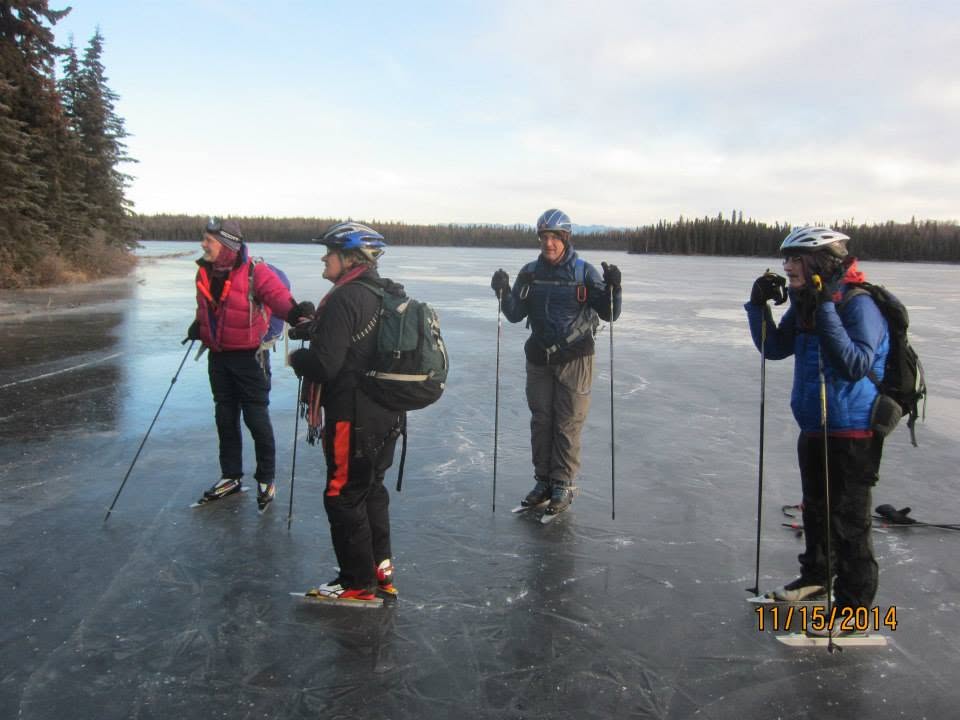
Jim Renkert and a group of friends skating at Nancy Lake State Recreation Area. Photo courtesy Richard Ragle
Where did you first start using Nordic skates in Alaska? What were those early experiences like?
Westchester Lagoon, Sand Lake and Goose Lake were the first locations. I can’t recall but for the first few winters we had good snow so skiing trumped skating and we weren’t able to get out on to the more exotic ice. On one of those early years though Bob Butera and I were on Nordic skates down Rabbit Slough. We had it all to ourselves. We were just about ready to turn around when we decided to go as far as a duck shack we could see in the distance. When we got off the slough and up to the duck shack we discovered all of the Palmer Hayflats. It was a wild ice Nirvana.
Did you have any experience with wild ice skating prior to using Nordic skates in Alaska?
Yes. As a kid in the ‘60s when the conditions were good we skated on the Chester Creek estuary before it was dammed up to create Westchester Lagoon. At Middlebury in 1978 we did some great skating during winter break on the flooded fields below what is now Bicentennial Hall. At one point we crawled on our hands on knees across Weybridge Street to get to the fields on the other side. Didn’t want to dull our blades on the asphalt.
We also went out and skated part of Otter Creek and flooded fields out by Snake Mountain. It was terrific weaving in and out among some trees in an area where it had flooded and frozen.
In the winter of 1995-1996 Alaska had a poor snow year, and several of us seized the opportunity to backcountry skate as much as we could. We were on hockey skates. That winter we skated Portage Lake and Eklutna Lake (both for the first time), the Nancy Lake canoe system and Rabbit Slough (but we didn’t discover the hayflats). The most epic skate though, and still my second favorite day of skating after the Elfstedentocht, was the day in early December when four of us hiked up the Carter Lake Trail to Crescent Lake. We discovered windowpane clear foot thick ice. Skating in that high mountain lake surrounded by the peaks was stunning.
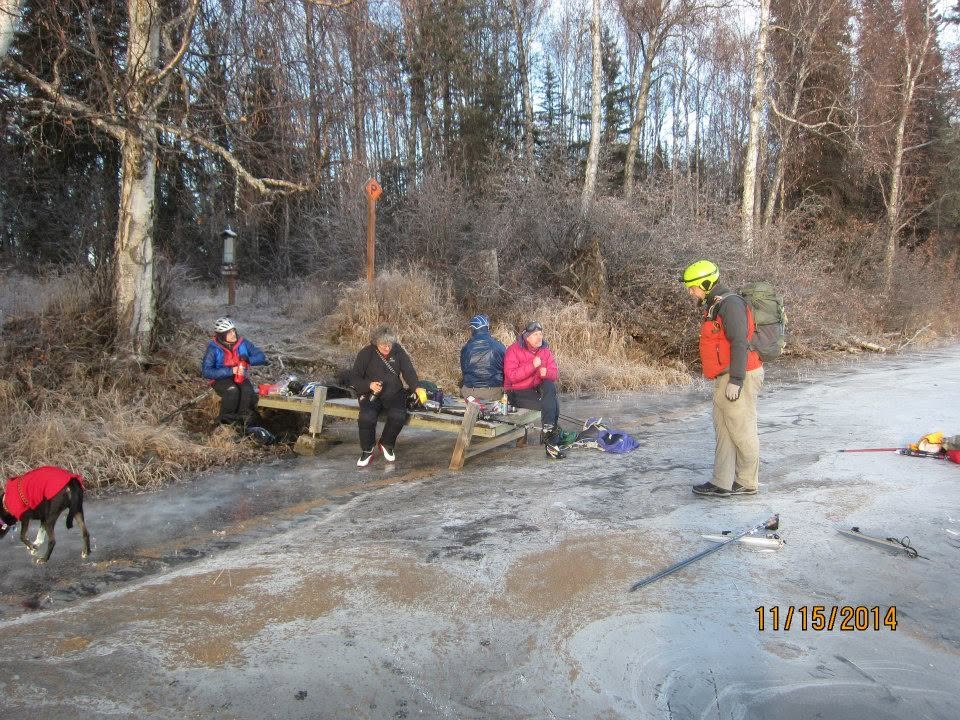
Jim Renkert and others getting ready to skate at Lynx Lake. Photo courtesy Richard Ragle
What was the wild ice skating community like in those early years? How did you find ice, or find people to skate with?
We didn’t call it wild ice back then. It was more likely to be just called something like backcountry skating. It was a fairly small community, but remember people have been skating on Alaska’s ponds and lakes for over 100 years. In the ‘90s we met a chap out skating that was born in Kenai in 1918 and made his own skates when he was growing up.
Because you never know what an Alaska winter will bring, we never knew where or when there would be good skating. Most years we got enough early snow to preempt good ice. Finding someplace to skate was pretty much watching the weather and calling around.
Skating buddies were mostly my backcountry skiing buddies who had also grown up skating.
From a commercial perspective, what was the market like? Were retailers able to sell skates successfully? Were customers actually interested in them?
It was a very small niche market initially, mostly outdoor types that had grown up skating on lakes and ponds. Nordic skiers that liked backcountry touring and hiking were the largest interest group. AMH was the only place to buy them locally. They were too small a market and too niche to approach bigger retail outlets like REI. Still are.
Here in 2026, the Nordic skating scene must look very different. What are the most significant changes you’ve seen?
Climate change, social media and the overall boom in outdoor recreation. We’ve always had the occasional dry and snowless months winters, but they’ve been getting more frequent, as have midwinter “resets” from major thawing and refreezing events.
Changes in the weather no longer shut down outdoor recreation in the winter. If you’ve got a pair of skis, a fatbike and Nordic skates you’ve got options and can find something to do no matter what the conditions.
With social media, as soon as someone finds good wild ice they can post it and the masses can get after it.
Technology has created better clothing and equipment, and that has helped create an overall boom in all kinds of outdoor recreation in Alaska. That’s a huge factor.
Did you expect Nordic skating to get as big in Alaska as it has?
Honestly, no I don’t think so. I knew it would grow but didn’t expect it to explode like it has in the last few years. I’m delighted to see how popular it has become and how a new generation is taking it to another level.
Have the changes in the Nordic skating community altered your own relationship with Nordic skating and wild ice?
No, not really. A good day on the ice is always fun. It brings a smile to see all the people out on Nordic skates.
I’m really glad to see the work that people like Luc Mehl are doing to emphasize safety and rescue.
Where do you see Nordic skating going in the next decade?
My Big Huge Audacious Outdoor Recreation Goal is that every kid that grows up in Anchorage, the Mat-Su Valley and the Kenai Peninsula learns to ice skate and ski by the time they’re out of 6th grade. We live in a winter state and skiing and skating are lifelong activities that kids and families can enjoy and stay healthy. Kids will naturally take part in other sports but once they learn to ski and skate they’ll always have that skill.
Nordic skates are comparatively inexpensive way to take part in winter recreation.
Join our email list
Sign up to receive updates on our latest products, new videos and resources, and more.